

AI Trends in the ERP Ecosystem
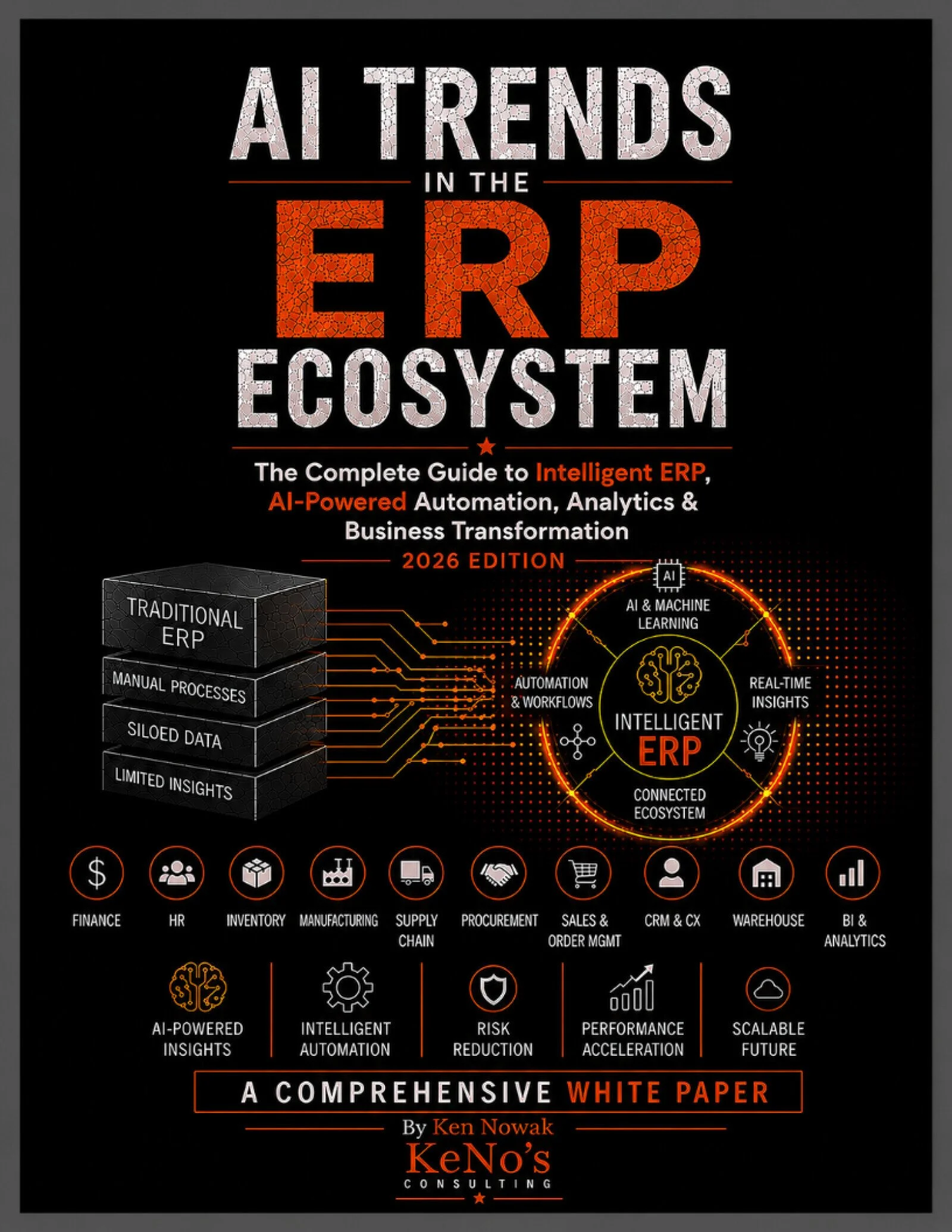
Explore how artificial intelligence is changing finance, operations, supply chains, and enterprise decision-making, and the opportunities and risks leaders should understand before moving forward.
Written for business leaders, ERP professionals, and digital transformation teams
This book provides a practical guide to how artificial intelligence is transforming the ERP ecosystem—from finance and supply chain to human resources, manufacturing, and analytics.
Written for business leaders and ERP professionals, it explores opportunities for smarter automation and decision-making, key adoption challenges, and considerations for shaping your organization’s AI and ERP strategy.
View the AI Trends in ERP Ecosystem Flipbook here:
The AI and ERP Challenge: Where Should You Start?
Your ERP system connects critical business processes. But identifying where AI can make a meaningful difference requires more than a list of new features.
Which activities are candidates for automation? Where could better predictions improve planning? What data, integration, and governance issues need attention before moving forward?
For business and technology leaders, the challenge is connecting AI possibilities to business priorities—and understanding the limitations alongside the opportunities.
AI Trends in the ERP Ecosystem provides a starting point for those conversations.
Explore AI Across the ERP Ecosystem
AI opportunities extend across departments and the processes that connect them. The following demonstrate how AI supports the Nine Core ERP Functions
Finance & Accounting: AI can improve cash flow forecasting, flag unusual transactions, and streamline routine financial tasks.
Human Resource Management: AI can support workforce planning, answer common employee questions, and simplify HR administration.
Inventory Management: AI can forecast demand, recommend replenishment, and help balance stock availability with inventory costs.
Manufacturing & Production: AI can identify potential equipment failures, monitor quality, and support production planning.
Customer Relationship Management: AI can prioritize leads, personalize customer interactions, and help teams respond to customer needs.
Supply Chain Management: AI can detect potential disruptions, improve logistics planning, and support more informed supply chain decisions.
Order Management / Sales: AI can improve sales forecasts, flag order exceptions, and streamline order processing.
Procurement: AI can categorize spending, identify potential supplier risks, and support purchasing decisions.
Warehouse Management: AI can optimize picking activities, support labor planning, and improve fulfillment efficiency.
Who is This For?
Designed for ERP Business & Technology Decision-Makers
Business and finance leaders
Build a clearer understanding of AI opportunities before discussing priorities and investment.
CIOs, IT leaders, and ERP teams
Put emerging capabilities into the context of enterprise systems and modernization.
Consultants and transformation professionals
Develop a broader perspective for conversations about AI and ERP.
Operations and supply chain professionals
Explore how emerging applications relate to planning and day-to-day business processes
What You Will Learn
Explore the trends shaping intelligent ERP and the questions they raise for your organization.
Automation opportunities: Understand how AI can support workflows and reduce repetitive work.
Predictive insights: Explore applications in forecasting, planning, and operational decisions.
Connected business functions: See how AI applications extend across the ERP ecosystem.
Adoption challenges: Consider the risks and practical issues that influence implementation.
Future direction: Understand the shift toward increasingly intelligent enterprise systems.
Key Takeaways
What You Will Be Able to Do
After reading AI Trends in the ERP Ecosystem, you’ll be better equipped to:
Identify AI opportunities across the nine core ERP functions and connect them to your organization’s business needs.
Recognize automation potential in repetitive tasks, manual workflows, and routine decisions.
Understand predictive applications that support forecasting, planning, and earlier detection of potential problems.
Ask better questions of ERP vendors about AI capabilities, integration requirements, and practical limitations.
Recognize readiness gaps involving data quality, connected systems, workforce skills, and organizational change.
Consider risks and oversight needs when evaluating AI-enabled processes and recommendations.
Contribute to AI and ERP planning discussions with a clearer understanding of emerging trends and their business implications.
About the Author
Ken Nowak
Ken is an IT and business transformation professional focused on ERP, AI, technology, business transformation & process improvement, data, integration, and program management.
Through KeNo's Marketing & KeNo’s Consulting, Ken provides practical perspectives and guidance for organizations navigating complex technology and business transformation initiatives.
His approach emphasizes simplification, practical execution, business alignment, and measurable outcomes.