

Application & Data Migration Best Practices
A Practical Approach to Planning, Executing & Delivering Successful Enterprise Migrations

Successfully moving applications and data requires far more than simply transferring information from one system to another. Application & Data Migration Best Practices (2026 Edition) provides a practical framework for developing a migration strategy, improving data quality, designing and executing migrations, testing results, planning cutover, and validating the new environment.
Data Migration is Often One of the Highest-Risk Parts of Enterprise Transformation
Organizations increasingly replace legacy applications, modernize ERP and CRM platforms, move workloads to the cloud, consolidate systems, and integrate or separate businesses following mergers and divestitures. In nearly every case, critical business data must move with them. These are all scenarios specifically addressed in the book.
View the Application & Data Migration Best Practices Flipbook here:
Why Application & Data Migration Matters
Migration Is Often One of the Highest-Risk Parts of Enterprise Transformation.
Organizations commonly undertake migrations to:
Modernize legacy systems and applications
Move applications and data to the cloud
Implement new ERP, CRM, SCM, HCM, and financial platforms
Support mergers, acquisitions, and divestitures
Consolidate applications and data environments
Improve reporting, analytics, and data quality
Reduce infrastructure and technology costs
Enable broader digital transformation
The Data Migration Challenge
Moving Data Is Easy. Moving the Right Data Correctly Is the Challenge.
Poorly planned migrations can result in missing or incomplete data, incorrect mappings, data-quality problems, inadequate testing, stakeholder communication issues, and incomplete cutover planning—all risks highlighted in the manuscript.
A successful migration must address multiple dimensions simultaneously:
Strategy & Governance: Define objectives, ownership, scope, decision-making, and success criteria.
Data Quality: Identify duplicates, incomplete records, inconsistent formats, and legacy-data problems.
Mapping & Transformation: Determine how source data will be cleaned, transformed, and mapped into the target environment.
Execution & Automation: Build repeatable ETL/ELT processes and migration routines.
Testing & Validation: Verify completeness, accuracy, integrity, relationships, and business usability.
Cutover & Business Continuity: Coordinate the final migration while controlling downtime and operational risk.
Data Migration Methodology
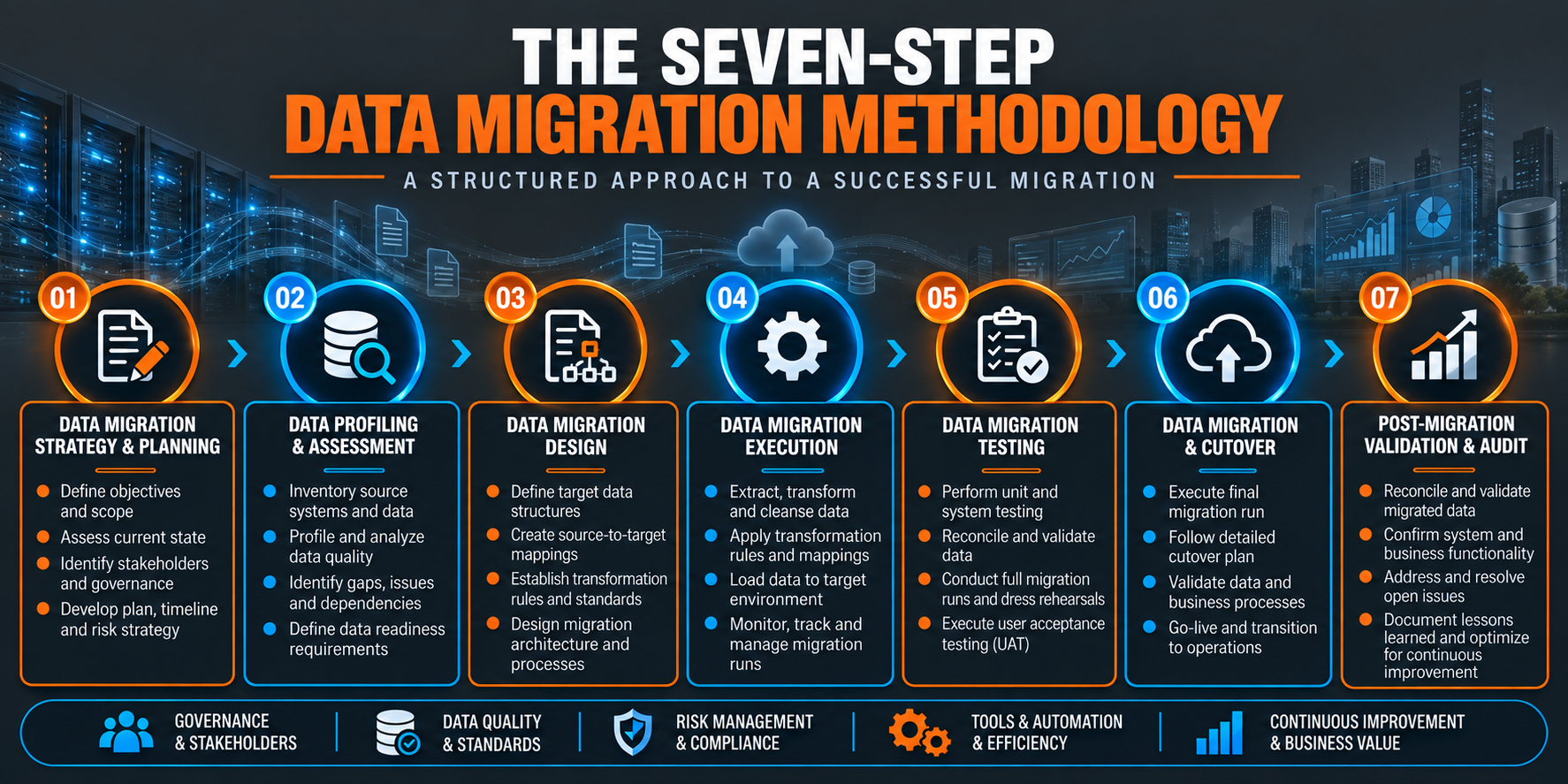
A Structured Seven-Step Approach to Data Migration
Successful migrations are built through a sequence of connected activities—not a single technical event. The book presents a seven-stage migration lifecycle that moves from strategy through post-migration validation.
Data Migration Strategy & Planning: Define objectives, scope, stakeholders, approach, timeline, risks, and success criteria.
Data Profiling & Assessment: Inventory source systems, profile data, identify quality issues, and understand dependencies.
Data Migration Design: Define target structures, mappings, transformation rules, standards, and migration architecture.
Data Migration Execution: Extract, transform, cleanse, and load data into the target environment.
Data Migration Testing: Validate mappings, data quality, completeness, reconciliation, performance, and business processes.
Data Migration & Cutover: Execute the final migration, coordinate cutover activities, and transition operations.
Post-Migration Validation & Audit: Reconcile results, validate business acceptance, resolve issues, and capture lessons learned.
Who is This For?
Built for Leaders Responsible for Enterprise Change
This book is designed for professionals involved in enterprise application implementations, modernization programs, digital transformation, and data migration initiatives.
Ideal readers include:
CIOs, CTOs, and technology executives
IT and business leaders
Program and project managers
Data architects and migration leads
Business and data analysts
ERP and CRM implementation teams
Transformation leaders
Consultants and solution architects
What You Will Learn

A Practical View of the Complete Migration Journey
This book takes readers through the major strategic, business, data, and technical considerations involved in planning and executing an enterprise migration.
You will learn how to:
Define a migration strategy and establish clear objectives
Choose between Big Bang, Phased, Parallel, and Hybrid migration approaches
Establish governance, ownership, roles, and responsibilities
Discover, profile, and assess source data
Identify and address data-quality issues
Design source-to-target mappings and transformation rules
Plan ETL/ELT and migration execution
Structure migration testing and reconciliation
Prepare detailed cutover plans and dress rehearsals
Validate and optimize the post-migration environment
Avoid common migration risks and pitfalls
Prepare for emerging migration technologies and trends
Key Takeaways
Turn Migration Into a Managed Business Transformation
After reading Application & Data Migration Best Practices, readers should be better prepared to:
Develop a structured migration strategy
Select an appropriate migration approach
Establish effective governance and data ownership
Improve data quality before migration
Design mappings and transformation rules
Coordinate migration execution and testing
Build a comprehensive cutover plan
Validate migrated data and business processes
Reduce operational and data-related risk
Create a stronger foundation for future transformation
About the Author
Ken Nowak
Ken is an IT and business transformation professional focused on Supply Chain & ERP transformation, AI, technology, process improvement, data, integration, and program management.
Through KeNo's Marketing & KeNo’s Consulting, Ken provides practical perspectives and guidance for organizations navigating complex technology and business transformation initiatives.
His approach emphasizes simplification, practical execution, business alignment, and measurable outcomes.