

ORACLE NETSUITE REIMPLEMENTATION PLAYBOOK (2026 Edition)
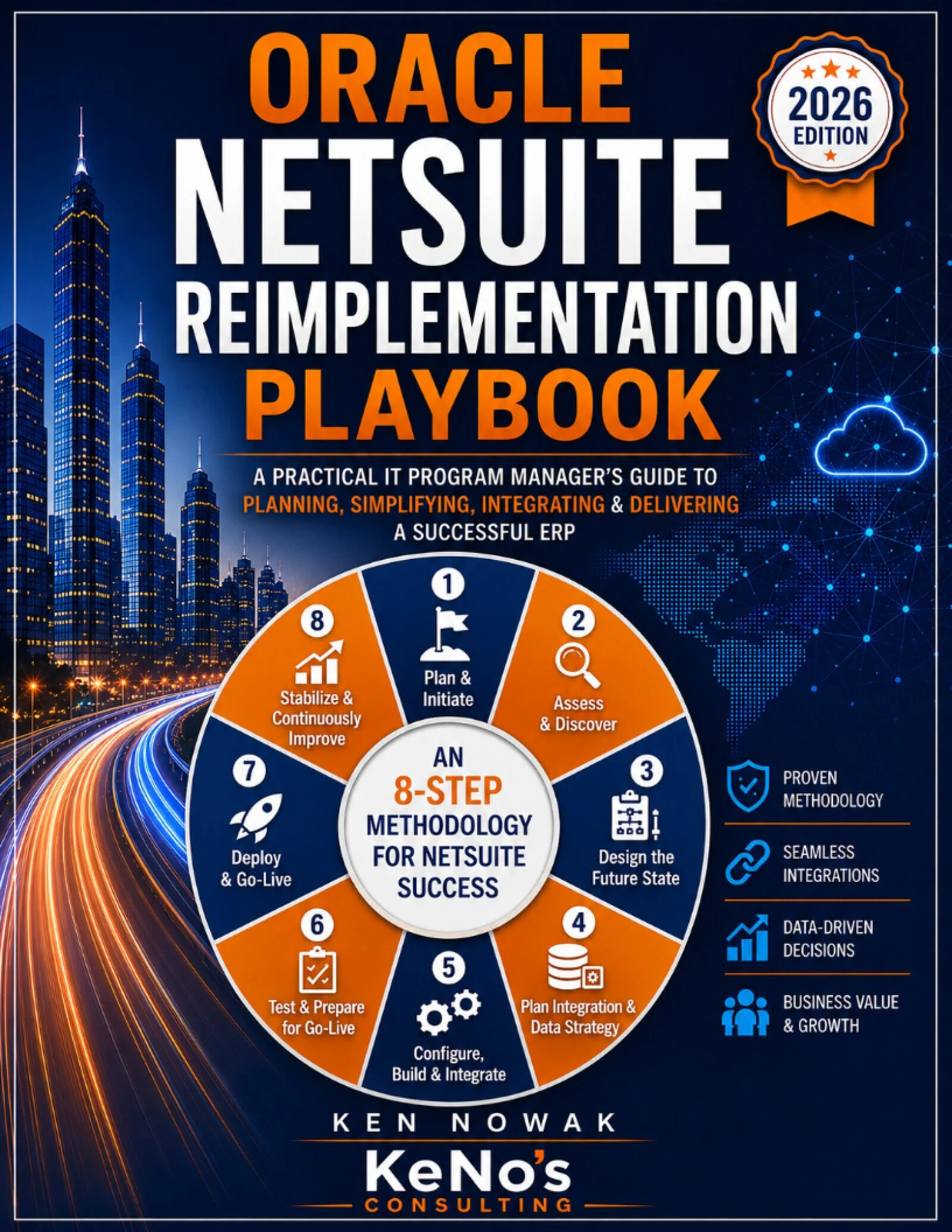
A Practical IT Program Manager's Guide to Planning, Simplifying, Integrating & Delivering a Successful ERP
Reimplementing an ERP is more than configuring software. It is an opportunity to simplify business processes, modernize the technology landscape, improve data and integrations, and build an ERP environment designed for the future.
View the Oracle NetSuite Reimplementation Guide FlipBook here:
Why This Book?
ERP Reimplementation Is More Than Software
An ERP reimplementation is an opportunity to rethink how the organization operates—not simply reproduce the existing environment in a new configuration.
The Oracle NetSuite Reimplementation Playbook provides a practical framework for IT Program Managers responsible for leading an ERP transformation from planning and discovery through design, integration, testing, go-live, and continuous improvement.
The focus is on building a simpler, more integrated, more scalable ERP environment while avoiding unnecessary customization and complexity.
The 8-Step Methodology
A Practical 8-Step NetSuite Reimplementation Methodology
The eight-step methodology provides a structured framework for managing the entire NetSuite reimplementation lifecycle. Each step builds on the previous one while maintaining focus on business value, process simplification, integration, data quality, risk management, and long-term sustainability.
Plan & Initiate
Assess & Discover
Design the Future State
Plan Integration & Data Strategy
Configure, Build & Integrate
Test & Prepare for Go-Live
Deploy & Go-Live
Stabilize & Continuously Improve
What is Inside the Guide?
Inside the Guide:
1. Plan & Initiate: Establish the business case, program structure, governance, scope, objectives, and implementation roadmap.
2. Assess & Discover: Understand the current environment, processes, applications, integrations, data, reporting, and organizational requirements.
3. Design the Future State: Define the future-state operating model, business processes, NetSuite architecture, security, controls, reporting, and governance.
4. Plan Integration & Data Strategy: Establish the integration architecture, data strategy, migration approach, ownership, and analytics requirements.
5. Configure, Build & Integrate: Configure NetSuite, develop required extensions, build integrations, and establish the future-state environment.
6. Test & Prepare for Go-Live: Execute functional, integration, end-to-end, user acceptance, data, security, and operational readiness testing.
7. Deploy & Go-Live: Execute the cutover plan, migrate final data, activate integrations, validate the environment, and transition into production.
8. Stabilize & Continuously Improve: Manage hypercare, resolve issues, transition to steady-state support, measure performance, and establish continuous improvement.
What You’ll Learn?
Simplify Business Processes
Learn how to challenge unnecessary process variation and design a future state around standard NetSuite capabilities.
Build a Sustainable ERP Architecture
Understand how NetSuite fits within the broader enterprise technology landscape.
Rationalize Customization
Apply the principle:
Standard functionality first → Configure when possible → Customize when necessary → Develop only when justified
Design Better Integrations
Establish a practical approach to APIs, integration architecture, application ownership, and downstream analytics.
Improve Data & Reporting
Address data ownership, migration, governance, reconciliation, analytics, and reporting as part of the ERP design.
Manage Go-Live Risk
Use structured testing, cutover planning, business validation, and go/no-go criteria to improve implementation readiness.
Create a Sustainable Operating Model
Move beyond go-live toward stabilization, governance, measurement, and continuous improvement.
Who is This Book For?
Who Should Read This Book?
Whether you are replacing a fragmented ERP environment, restructuring an existing NetSuite implementation, or preparing for a major business transformation, this playbook provides a practical framework for organizing the work and managing the decisions that matter most.
This book is particularly useful for:
IT Program Managers
ERP Program Managers
ERP Project Managers
NetSuite Program Leads
Enterprise Architects
IT Directors & CIOs
Business Transformation Leaders
Business Process Owners
Systems Integrators & Consultants
Organizations planning a NetSuite reimplementation or major transformation
What Makes This Guide Different?
Built for the Program Manager
“ERP implementations often fail because the organization treats them as technology projects instead of business transformation programs.’
This playbook focuses on the decisions and management disciplines required to keep business and technology aligned.
The Program Manager's focus:
Business Alignment
Keep the program connected to measurable business outcomes.
Decision Management
Make critical design and scope decisions visible, owned, and timely.
Cross-Workstream Coordination
Connect process, architecture, data, integration, testing, security, and organizational readiness.
Risk & Dependency Management
Identify issues before they become schedule or budget problems.
Executive Governance
Provide leadership with clear decisions, risks, dependencies, and progress.
Go-Live Readiness
Ensure the organization—not just the software—is ready for production.
About the Author
Ken Nowak
Ken develops practical business and technology guidance focused on enterprise systems, IT program management, business transformation, and technology-enabled growth.
His work emphasizes practical frameworks, clear decision-making, and translating complex technology programs into actionable guidance for business and IT leaders.