

The Complete Guide to Revenue Transformation

Leveraging Salesforce, HubSpot, AI, and Revenue Operations to Accelerate Growth
Transform disconnected sales, marketing, customer success, technology, and data into an integrated revenue engine designed for predictable, sustainable growth.
Build a Modern Revenue Engine
Revenue growth becomes increasingly difficult when Marketing, Sales, Customer Success, technology, and data operate independently. Revenue Transformation brings these capabilities together around a shared strategy, connected processes, trusted data, and measurable business outcomes.
The Complete Guide to Revenue Transformation provides a practical framework for building a more integrated revenue organization using Salesforce, HubSpot, Revenue Operations, analytics, automation, and AI.
View the Complete Guide to Revenue Transformation Flipbook here:
Why Revenue Transformation Matters
Traditional Revenue Models Are Becoming Less Effective
Customers increasingly expect connected, personalized, and frictionless experiences across the entire buying journey. At the same time, many organizations continue to operate with disconnected teams, inconsistent processes, fragmented technology, and unreliable data.
Revenue Transformation helps organizations address these challenges by creating a unified operating model across the revenue lifecycle.
Organizations typically pursue Revenue Transformation to:
Break down Sales, Marketing, and Customer Success silos
Improve pipeline visibility and forecasting
Create more consistent customer journeys
Increase sales and marketing productivity
Improve customer retention and expansion
Connect CRM, marketing, analytics, and AI technologies
Establish trusted revenue data and KPIs
Create more predictable and sustainable growth
The Modern Revenue Engine
Five Pillars of Revenue Transformation
Successful Revenue Transformation requires more than implementing a new CRM or adding AI. It requires coordinated improvement across five fundamental pillars.
Business Strategy — Align revenue objectives, customer segments, markets, and growth priorities.
People — Bring Marketing, Sales, Customer Success, Revenue Operations, and leadership around common goals.
Process — Standardize how leads, opportunities, customers, renewals, and expansion opportunities move through the revenue lifecycle.
Technology — Use Salesforce, HubSpot, analytics, automation, integration, and AI to enable scalable revenue processes.
Data — Establish the quality, governance, reporting, and insights required for better decisions.
Business Outcomes
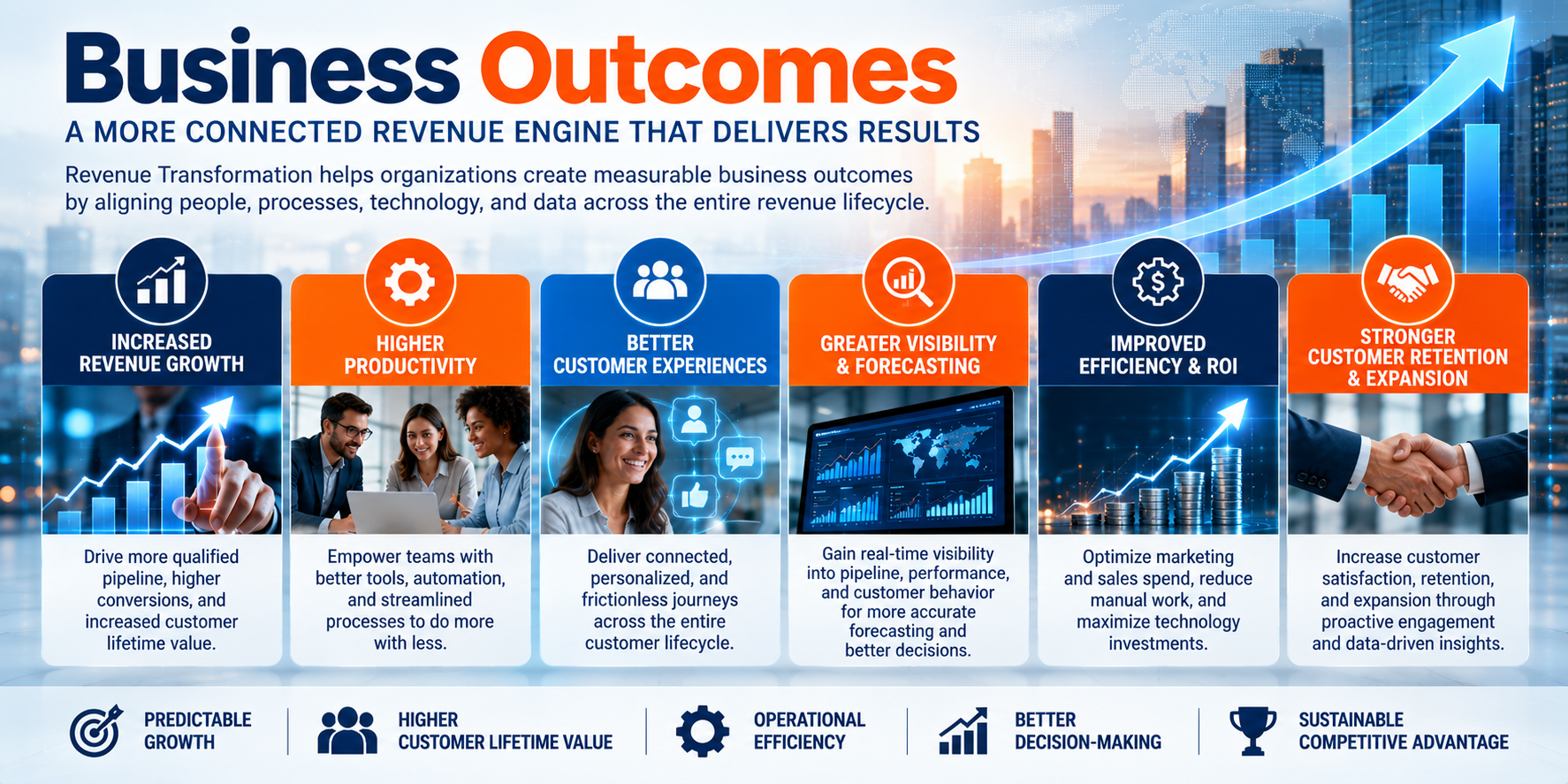
What Successful Revenue Transformation Can Deliver
The objective is not simply to implement Salesforce, deploy HubSpot, establish RevOps, or introduce AI. The objective is to create measurable improvements in how the business generates and retains revenue.
Potential outcomes include:
More Predictable Growth: Create greater visibility into pipeline, conversion, retention, and future revenue.
Higher Productivity: Reduce manual work and operational friction through standardized processes and automation.
Better Customer Experiences: Create more connected interactions across Marketing, Sales, and Customer Success.
Stronger Decision-Making: Give leaders trusted data, analytics, forecasting, and AI-powered insights.
Greater Revenue Efficiency: Improve the effectiveness of customer acquisition, sales execution, retention, and expansion.
Who is This For?
Built for Business and Technology Leaders
This book is designed for organizations evaluating or actively pursuing improvements across their revenue ecosystem, including:
CEOs, CIOs, CROs, CMOs, and technology leaders
Sales and Marketing leaders
Revenue Operations leaders
CRM and business application leaders
Salesforce and HubSpot teams
Customer Success leaders
Digital and business transformation leaders
Program and implementation leaders
What You Will Learn

A Practical Framework for Revenue Transformation
This book provides business and technology leaders with a practical view of how the major components of Revenue Transformation fit together.
Readers will learn how to:
Define Revenue Transformation and its business value
Identify why traditional revenue models stall
Build a modern revenue engine around five core pillars
Determine where Salesforce and HubSpot fit
Establish Revenue Operations as a growth accelerator
Apply AI across the revenue lifecycle
Build a phased Revenue Transformation roadmap
Establish KPIs to measure business results
Key Takeaways
Build a More Connected, Predictable Revenue Engine
Revenue Transformation is about more than implementing a CRM or adding new technology. It brings together strategy, people, process, technology, and data to create an integrated approach to acquiring, growing, and retaining customers.
Key takeaways include:
Align the Revenue Organization — Connect Marketing, Sales, Customer Success, and RevOps around shared goals, processes, and KPIs.
Build an Integrated Technology Ecosystem — Use Salesforce, HubSpot, analytics, integration, automation, and AI as components of a connected revenue platform.
Standardize the Revenue Lifecycle — Create consistent processes from lead generation and opportunity management through onboarding, retention, and expansion.
Turn Data Into Actionable Insights — Establish trusted data, reporting, analytics, and forecasting to improve visibility and decision-making.
Use AI to Amplify Performance — Apply AI to lead scoring, opportunity intelligence, forecasting, customer insights, and automation.
Measure What Matters — Track revenue, conversion, pipeline, retention, expansion, productivity, and other KPIs tied to business outcomes.
Create Sustainable Growth — Continuously optimize the revenue engine to improve efficiency, customer experience, predictability, and long-term growth.
The goal is not simply to transform Sales or Marketing—it is to create one connected revenue engine that continuously turns strategy, customer insight, technology, and data into measurable growth.
About the Author
Ken Nowak
Ken is an IT and business transformation professional focused on Supply Chain & ERP transformation, AI, technology, process improvement, data, integration, and program management.
Through KeNo's Marketing & KeNo’s Consulting, Ken provides practical perspectives and guidance for organizations navigating complex technology and business transformation initiatives.
His approach emphasizes simplification, practical execution, business alignment, and measurable outcomes.