

The Salesforce Implementation & CRM Transformation Guide (2026 Edition)

A Practical Guide to Planning, Designing, Configuring, Migrating & Delivering a Successful Salesforce Implementation
Salesforce implementations require much more than configuring a CRM platform. Success depends on aligning business strategy, processes, people, data, integrations, technology, and adoption around a clear implementation roadmap.
A Practical Roadmap for Salesforce Implementation Success
This book provides a structured approach for organizations implementing Salesforce for the first time, replacing an existing CRM, or migrating to a new Salesforce environment.
Rather than treating Salesforce as merely a technology deployment, the methodology integrates business requirements, process design, platform configuration, data, integrations, users, testing, and change management into a single coordinated implementation approach.
View the Salesforce Implementation Guide Flipbook here:
Why Salesforce Implementations Are Challenging
Salesforce Success Requires More Than Technology
Salesforce is highly configurable & extensible, but that flexibility can introduce complexity. Organizations can struggle when technology decisions get ahead of business requirements, legacy processes are recreated unnecessarily, data quality is underestimated, integrations are poorly planned, or users are introduced too late.
Common implementation challenges include:
Unclear business objectives and requirements
Over-customization and unnecessary complexity
Poor data quality and migration planning
Complex integrations and system dependencies
Misaligned business processes
Security and access design challenges
Insufficient testing and user preparation
Low adoption after go-live
A successful implementation requires balancing business needs, platform capabilities, technical discipline, and user adoption from the beginning.
Two Common Implementation Scenarios
Different Starting Points. One Disciplined Methodology.
The methodology can be applied to two common implementation scenarios:
New Salesforce Implementation
Establish Salesforce as a new CRM platform by defining business requirements, designing future-state processes, configuring the platform, preparing users, and deploying the solution.
CRM or Salesforce Migration
Transition from an existing CRM or Salesforce environment while determining what should be migrated, transformed, redesigned, replaced, archived, or retired.
8-Step Salesforce Implementation Methodology
From Strategy to Sustainable Business Value
The book provides an end-to-end methodology for moving from implementation strategy through go-live and continuous improvement.
1. Plan & Initiate
Define the vision, objectives, scope, implementation plan, team, governance, and readiness.
2. Assess & Discover: Understand current processes, data, integrations, technology, stakeholder requirements, and opportunities.
3. Design the Future State: Define future processes, Salesforce capabilities, architecture, user experience, and solution design.
4. Plan Data & Integration Strategy: Establish the approach for data migration, governance, integration architecture, and system connectivity.
5. Configure, Build & Automate: Configure Salesforce, build required extensions, automate processes, implement security, and prepare the solution.
6. Test & Prepare for Go-Live: Validate end-to-end processes, integrations, data, user readiness, training, and cutover plans.
7. Deploy & Go-Live: Execute deployment and data cutover, activate users and integrations, and stabilize the production environment.
8. Stabilize & Continuously Improve: Drive adoption, monitor performance, optimize the platform, and establish an ongoing improvement roadmap.
Business Outcomes
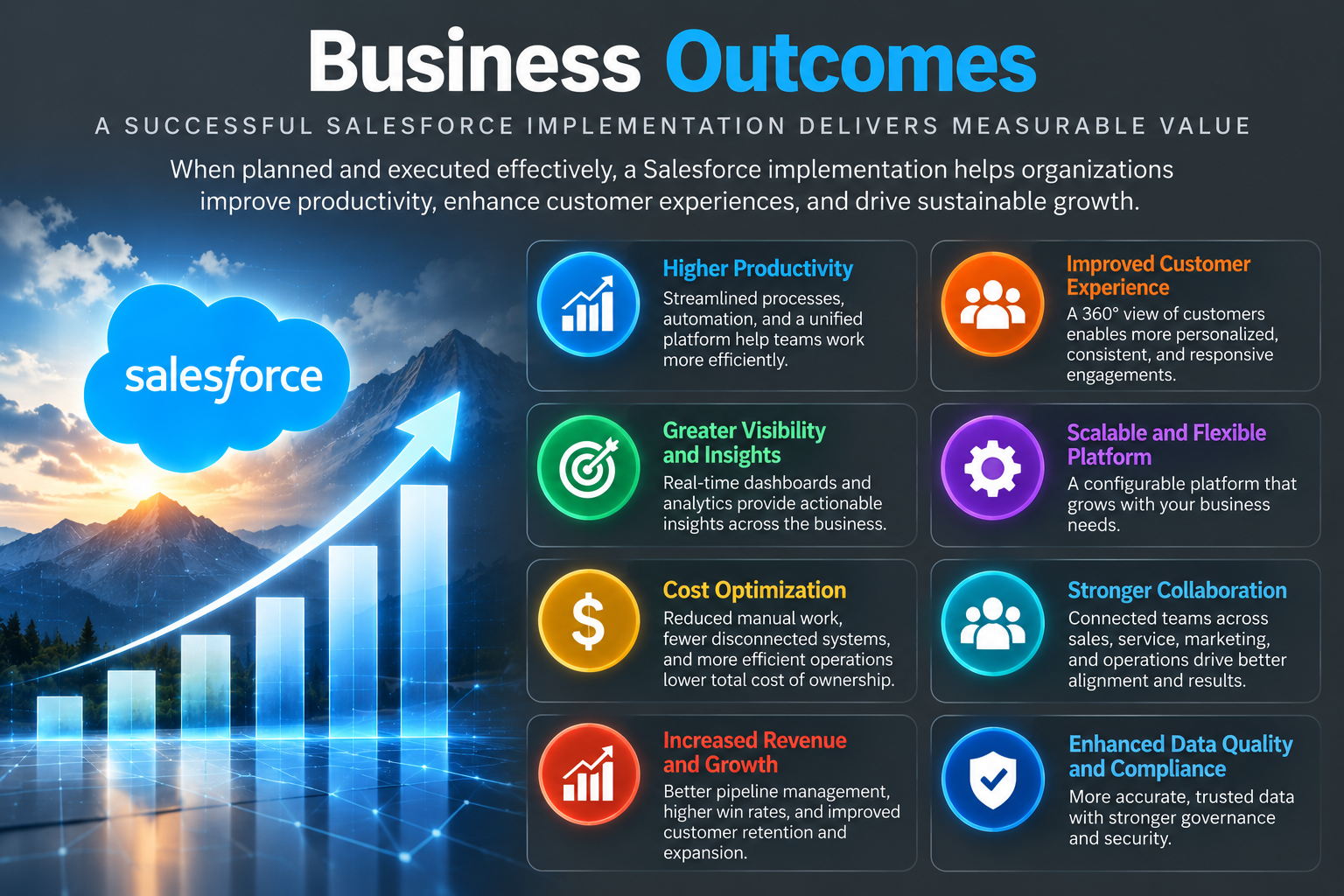
Turn Salesforce Investment Into Business Value
A disciplined Salesforce implementation can create a stronger foundation for customer engagement, revenue operations, service delivery, analytics, and future innovation.
Potential outcomes include:
More consistent sales and customer processes
Improved customer and pipeline visibility
Higher-quality and more trusted CRM data
Better integration across enterprise systems
Increased process automation and productivity
Stronger reporting and decision-making
Improved user experience and adoption
A scalable platform for future growth, analytics, and AI
Who is This For?
Designed for Business and Technology Leaders
The Salesforce Implementation Guide is designed for professionals responsible for planning, leading, supporting, or governing Salesforce initiatives, including:
IT Program & Project Managers • Salesforce Product Owners • Business Leaders • CRM Leaders • Salesforce Administrators • Solution Architects • Business Analysts • Data & Integration Teams • Transformation Leaders • Implementation Consultants
It should also work well for executives who need to understand how the pieces of a Salesforce implementation fit together without requiring deep platform-development expertise.
What You Will Learn
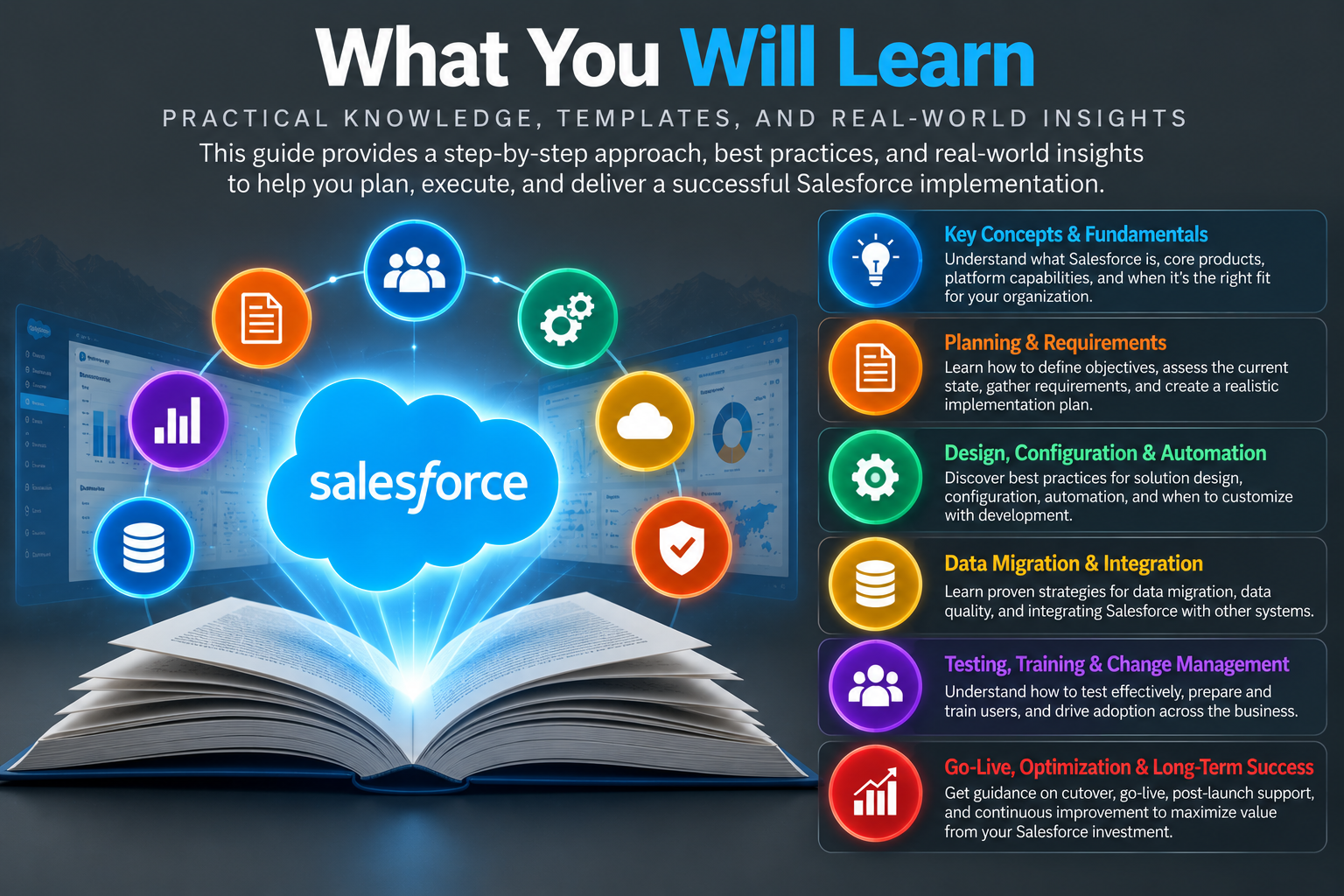
Build the Knowledge to Lead Salesforce Implementations with Confidence
The book explains how to:
Establish Salesforce implementation scope, objectives, governance, and success measures
Assess current business processes, systems, data, and integrations
Design a scalable future-state Salesforce solution
Make better configuration versus customization decisions
Develop effective data migration and integration strategies
Configure, build, and automate Salesforce capabilities
Plan and execute testing, training, cutover, and go-live
Improve user adoption and post-go-live performance
Establish a roadmap for continuous Salesforce improvement
Key Takeaways
A Practical Framework You Can Apply to Real Projects
After working through the book, readers will have a structured approach for taking a Salesforce initiative from concept through implementation and into ongoing optimization.
Key takeaways include:
Start with business outcomes—not Salesforce features
Simplify processes before automating them
Configure before customizing
Address data quality before migration
Design integrations around clear systems of record
Build security into the solution from the beginning
Test complete business processes, not isolated functionality
Prepare users before go-live
Measure adoption, performance, and business value after launch
[ READY TO EXPLORE YOUR SALESFORCE IMPLEMENTATION STRATEGY?]
About the Author
Ken Nowak
Ken is an IT and business transformation professional focused on Supply Chain & ERP transformation, AI, technology, process improvement, data, integration, and program management.
Through KeNo's Marketing & KeNo’s Consulting, Ken provides practical perspectives and guidance for organizations navigating complex technology and business transformation initiatives.
His approach emphasizes simplification, practical execution, business alignment, and measurable outcomes.