

Digital Supply Chain Implementation Guide (2026 Edition)

A practical guide to evaluating, selecting, implementing, and optimizing modern Digital Supply Chain solutions—including ERP, MRP, APS, MOM, and WMS—to build more connected, intelligent, and resilient operations.
Modern Supply Chains Require Modern Solutions
Today's supply chains must respond to changing customer expectations, global disruptions, labor shortages, and increasing demands for speed, visibility, and efficiency. This guide provides a practical roadmap for organizations looking to modernize supply chain operations through integrated planning, manufacturing, warehouse management, enterprise integration, and Artificial Intelligence.
Whether you're implementing a new Digital Supply Chain platform or modernizing existing capabilities, this guide shares proven methodologies, implementation best practices, and practical recommendations to help reduce risk and accelerate business value.
View the Digital Supply Chain Implementation Guide Flipbook here:
Our Digital Supply Chain Methodology
Our proven methodology provides a structured roadmap for planning, implementing, and optimizing a successful Digital Supply Chain transformation.
Assess & Define – Establish business objectives, scope, and success criteria.
Design & Plan – Design the future state and develop the implementation roadmap.
Select & Prepare – Choose the right solution and prepare your organization for success.
Configure & Integrate – Configure the solution and connect enterprise systems and data.
Test & Validate – Verify business processes, integrations, and solution readiness.
Train & Prepare – Equip users and stakeholders for a successful go-live.
Deploy & Optimize – Launch the solution and continuously improve business performance.
Why Organizations Modernize their Supply Chains
Modern Digital Supply Chain solutions connect people, processes, technology, and data to improve visibility, efficiency, resilience, and business performance.
Organizations modernize to:
Improve end-to-end visibility
Increase operational efficiency
Reduce costs and waste
Improve agility and responsiveness
Build a more resilient supply chain
Deliver a better customer experience
Prepare for AI-driven innovation
Who is This For?
Ideal for
CIOs
Supply Chain Leaders
Manufacturing Executives
Operations Leaders
ERP Program Managers
Digital Transformation Leaders
IT Directors
Manufacturing Managers
Solution Architects
Consultants
System Integrators
What You Will Learn
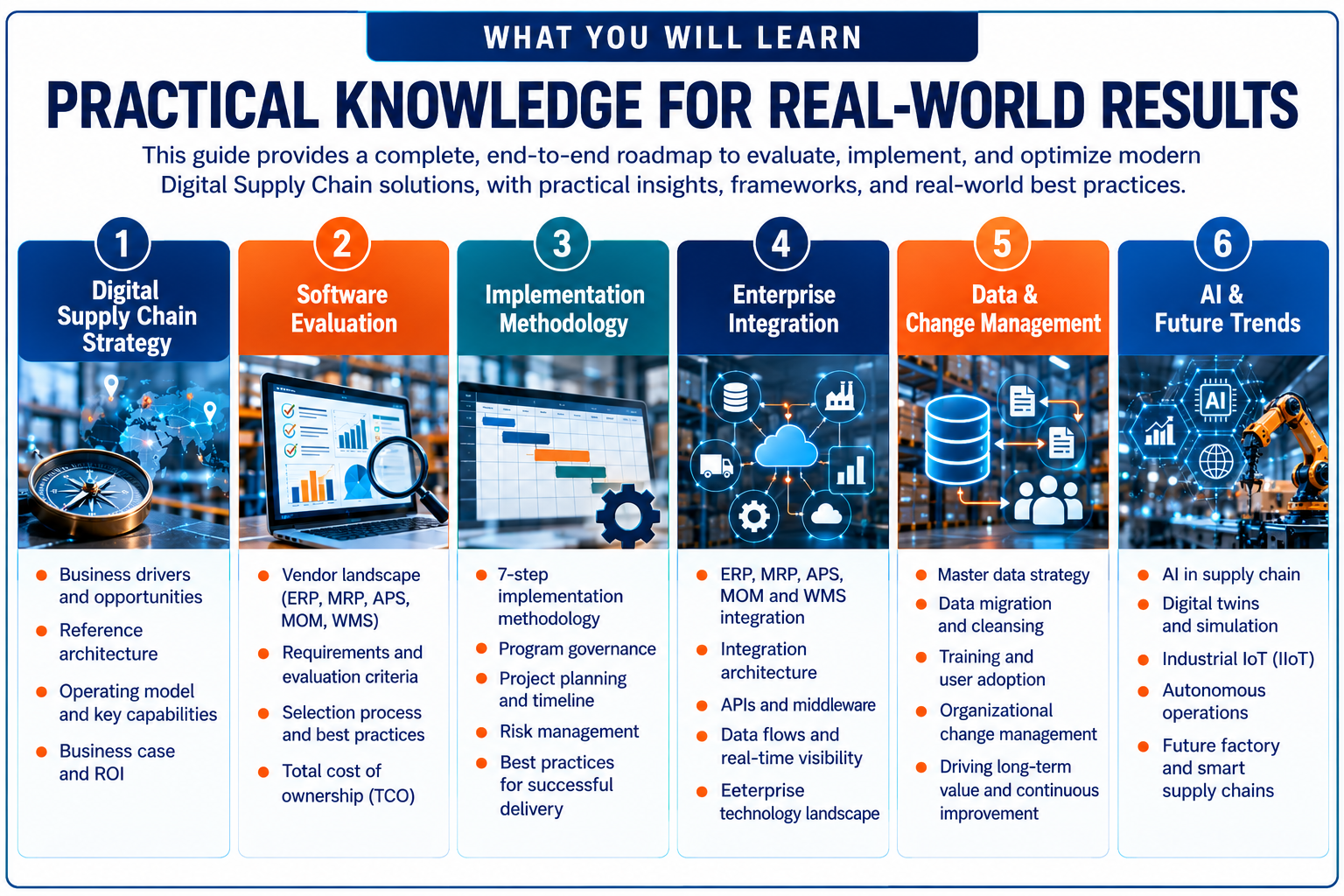
Build the Knowledge to Successfully Modernize Your Digital Supply Chain
Whether you're evaluating new supply chain technologies or leading an enterprise-wide transformation, this guide provides practical frameworks, proven methodologies, and real-world best practices to help you make informed decisions and successfully implement modern Digital Supply Chain solutions. Throughout this guide, you'll learn how to:
Understand the Digital Supply Chain and the business value of connected operations.
Evaluate leading supply chain platforms including ERP, MRP, APS, MOM, and WMS.
Select the right solution using structured evaluation criteria and best practices.
Implement Digital Supply Chain solutions using a proven step-by-step implementation methodology.
Integrate enterprise applications and data to enable real-time visibility and collaboration.
Manage master data, migration, and organizational change to improve adoption and reduce implementation risk.
Leverage Artificial Intelligence (AI) and emerging technologies to build a more intelligent, agile, and future-ready supply chain.
Key Takeaways
What You Will Be Able to Do
Gain the knowledge and practical frameworks needed to confidently evaluate, implement, and optimize a modern Digital Supply Chain. After reading this guide, you'll be able to:
Understand the core technologies that power the Digital Supply Chain, including ERP, MRP, APS, MOM, and WMS.
Evaluate leading software solutions and select the platforms that best fit your organization's needs.
Develop a compelling business case that aligns technology investments with strategic business objectives.
Plan and deliver successful Digital Supply Chain implementations using a proven methodology and governance framework.
Integrate enterprise applications, data, and business processes into a connected, end-to-end ecosystem.
Improve data quality, user adoption, and organizational readiness to maximize long-term business value.
Leverage Artificial Intelligence (AI) and emerging technologies to build a more agile, intelligent, and future-ready supply chain.
About the Author
Ken Nowak
Ken is an IT and business transformation professional focused on Supply Chain & ERP transformation, AI, technology, process improvement, data, integration, and program management.
Through KeNo's Marketing & KeNo’s Consulting, Ken provides practical perspectives and guidance for organizations navigating complex technology and business transformation initiatives.
His approach emphasizes simplification, practical execution, business alignment, and measurable outcomes.