

ERP & Enterprise Transformation
Turn your core systems into a business advantage. Modernize platforms, processes, and ways of working to create a connected, resilient enterprise.
Transformation Opportunity
Modern ERP is more than a technology program. ERP transformation is an opportunity to redesign how the enterprise operates - not simply replace legacy systems.
You may be dealing with:
Legacy ERP platforms and processes that are costly, difficult to maintain, or no longer support the business
Disconnected systems, data, and teams that make it hard to operate as one enterprise
A major ERP initiative without a clear business case, delivery roadmap, or ownership model
Complex technology investments that are not delivering the expected operational or financial value
Manual workarounds, inconsistent processes, and limited visibility into performance
Uncertainty about what to modernize first—and how to create momentum without disrupting the business
The goal isn’t simply to implement a new ERP platform. It’s to create a more connected, efficient, and adaptable enterprise that delivers lasting business value.
ERP & Enterprise Transformation Methodology
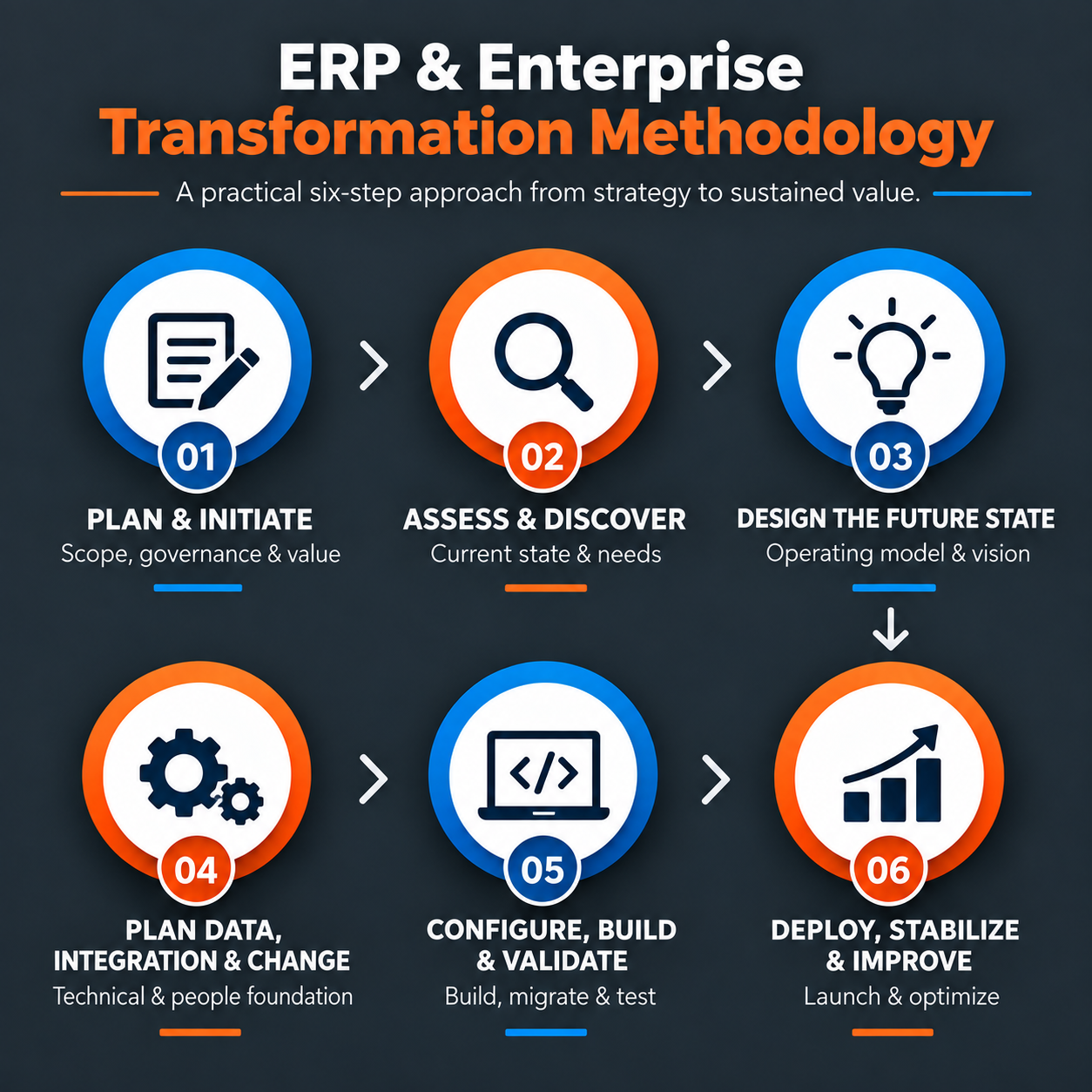
The following is our 6-step methodology used for ERP & Enterprise Transformation programs.
Plan & Initiate: Define scope, stakeholders, governance, objectives, timeline, and the transformation business case.
Assess & Discover: Evaluate current processes, systems, data, integrations, risks, and opportunities to establish a clear baseline.
Design the Future State: Define the target operating model, future-state processes, reporting, security, governance, and success measures.
Plan Data, Integration & Change: Prepare and cleanse data, map integrations, establish the technical foundation, and build the change-management and training plan.
Configure, Build & Validate: Configure the platform, develop reports and workflows, integrate connected systems, migrate data, and complete testing and user acceptance.
Deploy, Stabilize & Improve: Execute go-live, provide hypercare support, monitor adoption and performance, optimize processes, and identify continuous-improvement opportunities.
The goal isn’t simply to deploy a new ERP platform. It’s to create an enterprise foundation that supports better decisions, stronger performance, and sustainable growth.
How We Help
Bring every part of transformation into focus.
Depending on your needs, an ERP & Enterprise Transformation engagements can address:
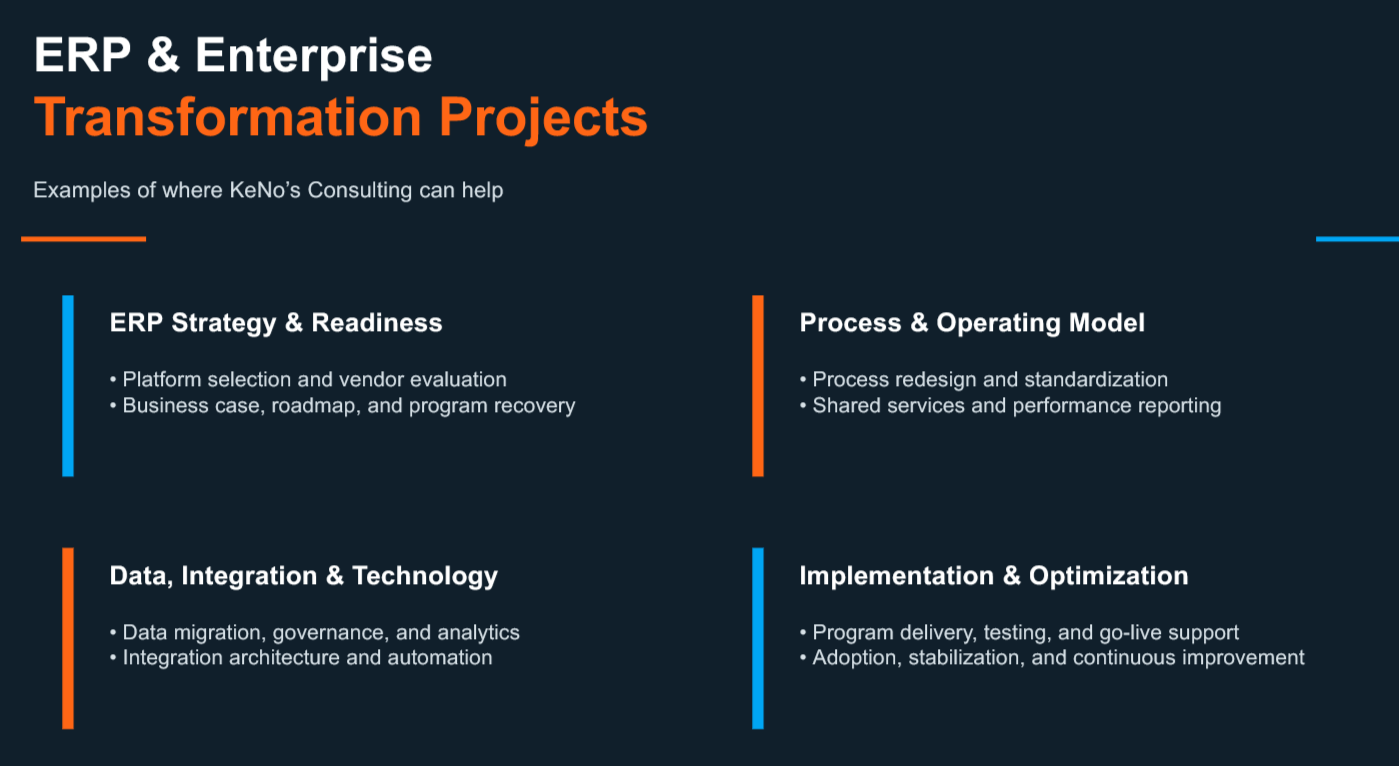
ERP Strategy & Readiness
ERP platform selection and vendor evaluation
ERP modernization roadmap and business case
Current-state assessment of systems, processes, data, and integrations
Target operating model and transformation governance design
Program recovery for delayed, over-budget, or underperforming ERP initiatives
Process & Operating Model Transformation
Finance, supply chain, manufacturing, service, or inventory process redesign
Process standardization across business units, locations, or acquired companies
Shared-services and back-office operating model design
Workflow simplification and manual-workaround reduction
KPI, reporting, and performance-management redesign
Data, Integration & Technology Enablement
Data strategy, governance, cleansing, and migration planning
Enterprise integration architecture and application rationalization
Automation opportunities across finance, operations, and customer processes
Reporting, dashboards, and decision-support improvements
Security, role design, controls, and compliance readiness
ERP Implementation & Optimization
Implementation planning, program management, and deployment support
Configuration, testing, cutover, and go-live readiness
Change management, communications, training, and adoption support
Post-go-live stabilization and hypercare
Continuous-improvement roadmaps, release planning, and value realization
Deliverables & Outcomes
The following are sample outputs that will be tailored to your transformation program and scope
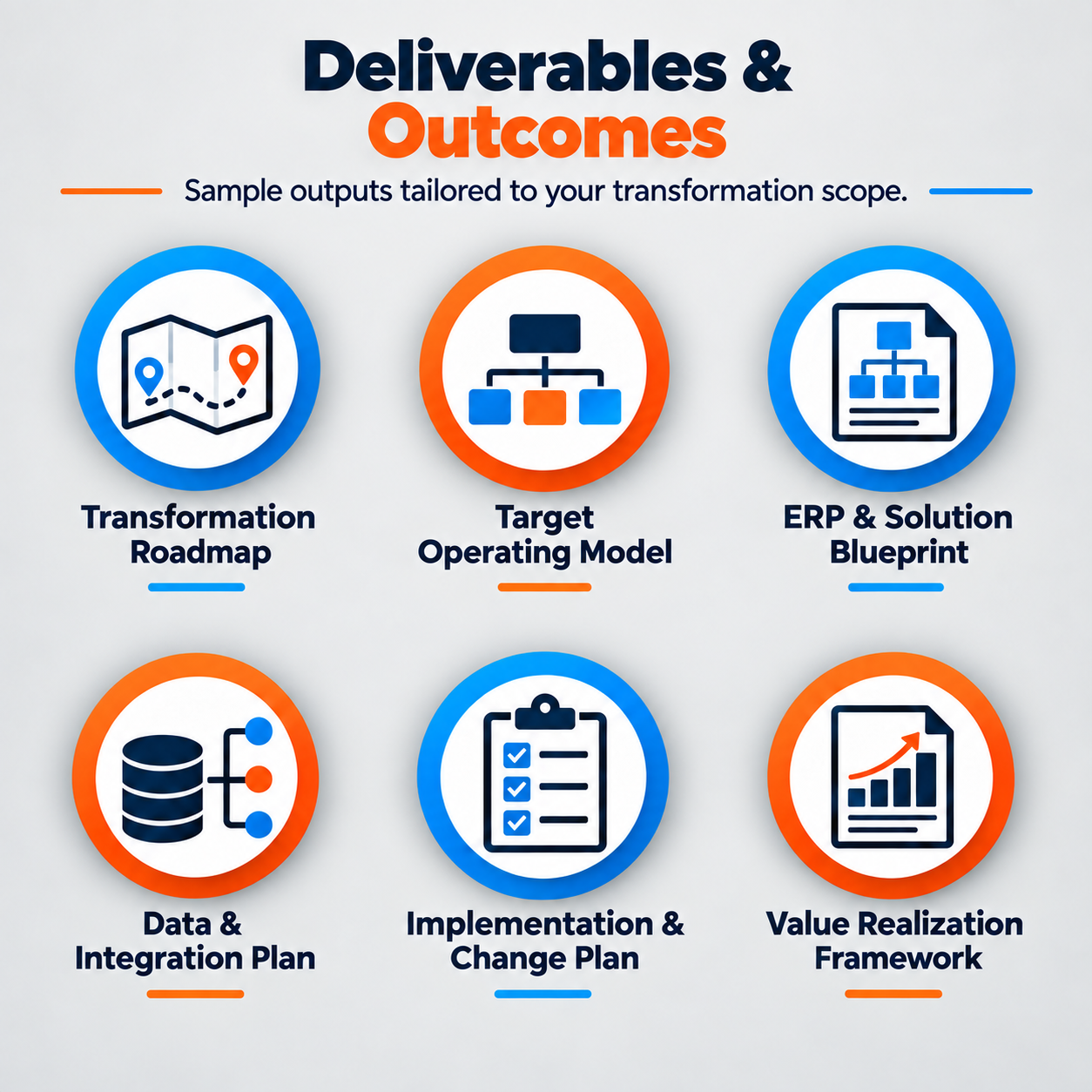
Sample deliverables you can receive:
A clear ERP and enterprise transformation roadmap aligned to your business priorities
A practical target operating model that connects people, processes, data, and technology
Prioritized recommendations for platform modernization, integrations, automation, and process improvement
A realistic implementation plan with governance, milestones, roles, risks, and resource requirements
Change-management and adoption support to prepare leaders and teams for new ways of working
A value-realization framework to track progress, measure outcomes, and sustain improvement
What It Enables
Clearer priorities and stronger decision-making across the enterprise
More standardized, efficient processes with less manual effort and fewer workarounds
Better visibility into operational and financial performance
A lower-risk path to ERP implementation, modernization, or optimization
Greater user adoption and confidence in new systems and processes
A stronger foundation for growth, agility, and continuous improvement
Ready to Turn Strategy into Action?
Whether you're planning growth, replacing legacy technology, preparing for enterprise transformation, or simply trying to determine what comes next, I can help develop a practical ERP & Enterprise Transformation strategy and roadmap.