

Epicor Kinetic ERP Implementation Guide (2026 Edition)
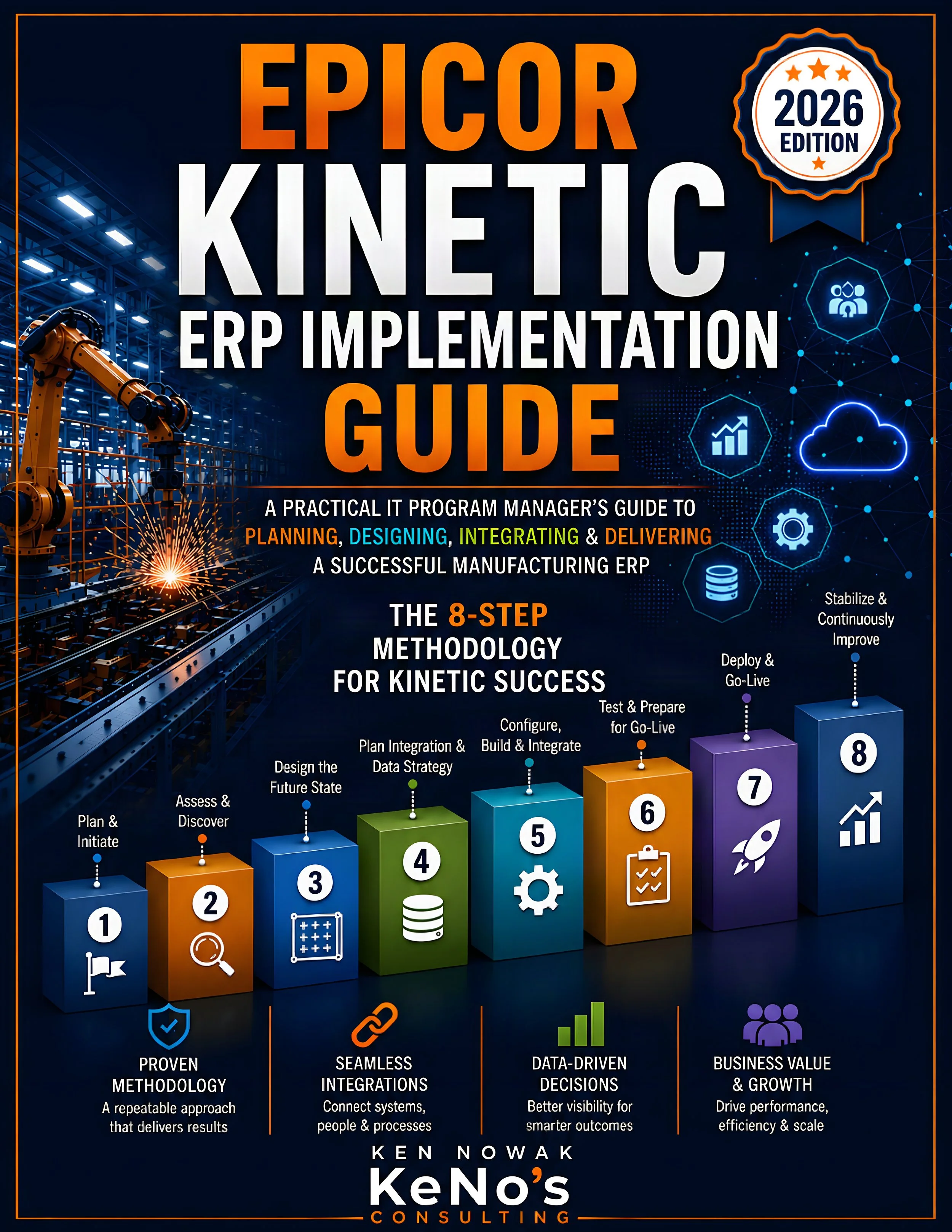
A Practical Guide to Planning, Designing, Integrating & Delivering a Successful Manufacturing ERP
A practical roadmap for planning and delivering an Epicor Kinetic ERP implementation- from initial assessment and future-state design through integration, testing, go-live, and continuous improvement.
Try the Epicor Kinetic ERP FlipBook here:
Why This Book?
ERP Implementation Is More Than Software
Implementing Epicor Kinetic requires more than configuring an ERP system. Successful programs bring together business processes, manufacturing operations, data, integrations, technology, people, governance, and organizational readiness.
This guide provides an eight-step implementation methodology designed to help IT Program Managers and implementation teams move from planning to production while keeping the program focused on simplicity, business value, and long-term scalability.
The 8-Step Methodology
A Practical 8-Step Epicor Kinetic Implementation Methodology
1. Plan & Initiate
Establish the business case, scope, governance, stakeholders, and implementation plan.
2. Assess & Discover
Understand current processes, systems, data, integrations, pain points, and opportunities.
3. Design the Future State
Define simpler, standardized processes and a scalable Kinetic solution.
4. Plan Integration & Data Strategy
Establish data ownership, migration requirements, integration architecture, and governance.
5. Configure, Build & Integrate
Turn the approved design into a working Kinetic solution while controlling customization and complexity.
6. Test & Prepare for Go-Live
Validate processes, data, integrations, security, users, training, and organizational readiness.
7. Deploy & Go-Live
Execute the cutover, transition the business, and stabilize the production environment.
8. Stabilize & Continuously Improve
Measure results, optimize processes, improve adoption, automate, and prepare for future growth.
What You’ll Learn Inside?
Inside the Guide, You’ll Learn How to:
Build a practical Epicor Kinetic implementation roadmap
Establish effective program governance and decision-making
Assess current-state processes, applications, data, and integrations
Design a simpler future-state operating model
Develop an effective data and integration strategy
Decide when to configure, extend, integrate, or customize
Coordinate testing, UAT, training, and organizational readiness
Plan and execute a controlled go-live and cutover
Establish effective post-go-live support and stabilization
Create a framework for continuous improvement and measurable business value
Who is This Book For?
Who Should Read This Book?
This guide is designed for:
IT Program Managers
Leading Epicor Kinetic implementation programs and coordinating multiple workstreams.
CIOs & IT Leaders
Responsible for ERP strategy, investment decisions, governance, and implementation outcomes.
Manufacturing & Operations Leaders
Looking to improve processes, visibility, standardization, and operational performance.
ERP & Transformation Teams
Supporting business process, data, integration, testing, deployment, and organizational change.
Epicor Kinetic Implementation Teams & Consultants
Looking for a structured framework for organizing and managing implementation activities.
What Makes This Guide Different?
Built for the Program Manager
Many ERP resources focus primarily on software functionality.
This guide focuses on how to successfully manage the implementation.
It connects:
Business Strategy
↓
Process & Manufacturing
↓
Epicor Kinetic
↓
Data & Integration
↓
People & Readiness
↓
Go-Live & Continuous Improvement
The emphasis throughout the book is on simplification, standardization, disciplined execution, and measurable business outcomes.
About the Author
Ken Nowak
Ken is an IT and business transformation professional focused on ERP, technology, business process improvement, data, integration, and program management.
Through KeNo's Marketing & KeNo’s Consulting, Ken provides practical perspectives and guidance for organizations navigating complex technology and business transformation initiatives.
His approach emphasizes simplification, practical execution, business alignment, and measurable outcomes.